Why I'm Building Airmond [Part 3 of 3]
Halfway through a video call with a friend in Hungary, I asked my assistant to give him a ring and ask what he thought of the product. His phone rang about twenty seconds later, and I sat there watching him take the call and try to catch her out.
He couldn't really, and afterwards the first thing he said was that there's still a bit of latency. Which is true, and I'll come back to it.
I got here because of a problem I ran into in part 2. To sell anything, you need more than an email address and a simple model behind it. You need something that behaves like a colleague. Someone I can brief the way I brief Bianka: here's the goal, here's where I'd start, now make this list better than I made it and go figure it out.
There was a second push in the same direction. I'd been showing Tartare to friends, and the reaction was consistent. They didn't want a hundred companies. They wanted it for their email. They wanted it for their filing.
So I built a separate system on top of the same engine. The memory, the way knowledge cascades, the way work gets delegated, the way inputs get matched to outputs. All of it, built into a single agent. We call it Airmond.
The thing all the others get wrong
There are maybe fifty products telling you they're your executive assistant. Superagent, hyperagent, and a long tail behind them.
If you actually use them, they're text-based. You sit down at a box and type. And they all feel fairly technical.
What I realised is that a lot of my friends who run businesses are never going to do that. They don't want to sit down and write a prompt and work out what an API key is. They just want the thing to work.
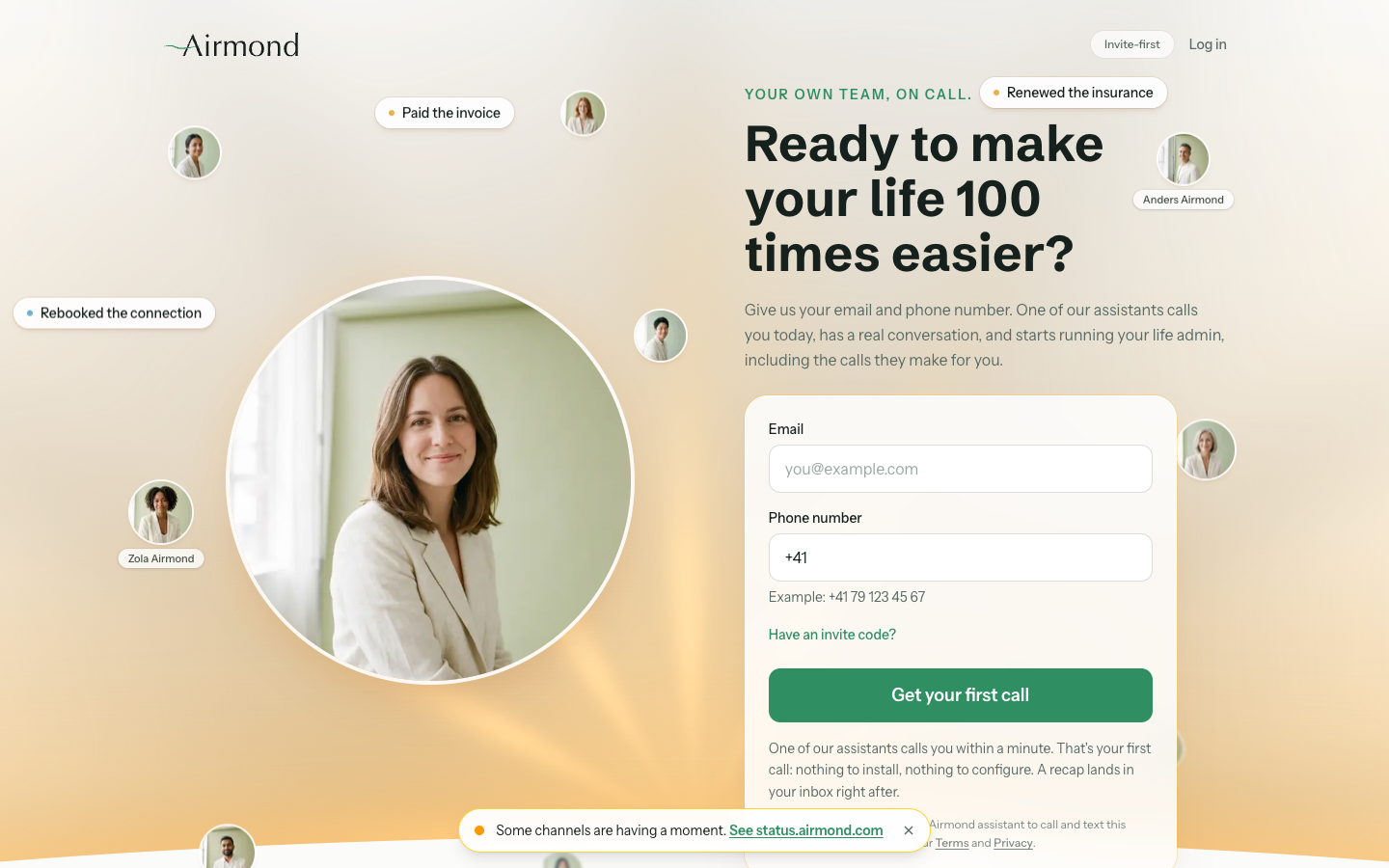
So Airmond onboards itself by calling you.
You give it your email address and your phone number. That's it. It goes and finds what's publicly available about you, your LinkedIn, your Facebook, your personal site, and builds a briefing. Then it phones you and says, hey, I know you signed up, is now a good time for a fifteen minute conversation.
Then you just talk. It asks about your family, about your businesses. Mine is called Ada, and everyone gets their own. The first time I did this I told her I had to jump off, could she call me back in fifteen minutes. She called me back in fifteen minutes.
Every conversation feeds the same pipeline and extracts new knowledge about you. When I demoed this to Ákos, Ada was sitting in the meeting, and I told him she'd be pulling our working history out of that conversation and researching him afterwards. She did.
Once she knows enough, she starts working out how to help. She'll ask for calendar access, which is a button press. If you mention you use Notion, she'll offer to set up the integration. And for a lot of executives she'll offer to email their IT person directly with what's needed, then handle it with them.
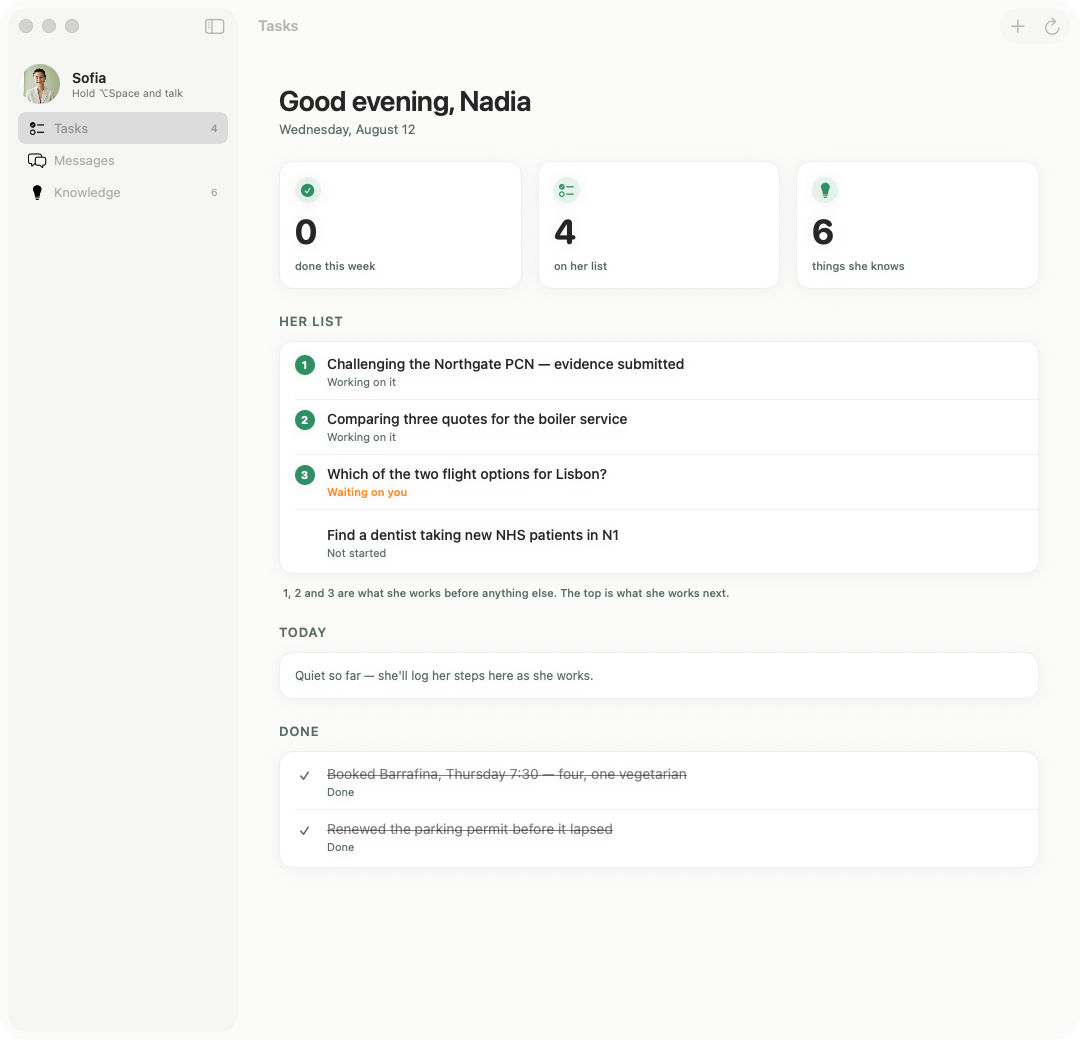
There's an app, built to feel like WhatsApp rather than like a terminal. You can call her from it. While you're talking, she shows you the facts and the tasks she's capturing on screen as they happen. In meeting mode you see the transcript alongside what she's learning, and you can go off the record. And she shows her top three tasks, and what she knows about you, so you can correct her.
Latency, and why I'm not that worried about it
The honest weak point right now is latency. There's still a beat before she responds.
I've got it down by about half, and I'm using some tricks, an occasional mm-hmm, a let me think, the things that make a conversation feel natural rather than transactional.
But we're already at the point where even when you know it's an AI, it's not as annoying as a sales call from a human. The first time you talk to her it's genuinely fun, and everyone tries to trick her.
Ákos made a good point after that call: OpenAI's live voice experience is excellent and isn't in the API yet, but it will be in a month or two. When it lands, this problem mostly solves itself. So it's the weakness I'm least worried about.
Where this goes
Airmond as it exists today is the consumer product. You sign up, it onboards you from the ground up, it becomes yours.
There are two more surfaces on the same engine.
The first is enterprise. If you're a large company you don't want every employee separately setting up the same API keys. What you need is a middle layer that defines how the company communicates, what's allowed, what the company knows, and which systems are pre-connected. Most of that already exists in the system, because that's what Tartare does for my own entities.
The second is family. We've built a WhatsApp integration, so you can add the agent to a group. Add the assistant, add the teacher, add whoever needs to be up to speed, and then the whole family coordinates in the same place while she keeps track of the details.
Two things I built for myself along the way
We're moving fast enough that even with a team of two we started stepping on each other. Joe and I would find ourselves working on the same pull request. So we built something called Latch, where agents have to register the task they're about to work on before they start. It's a step backwards to SVN, honestly. Check something out, and nobody else can touch that feature. They also talk to each other in there, asking how the other is approaching a task, which is fascinating to watch.
The other one is more personal. I built an app so I can tmux into my machine from my phone. All my Claude sessions in one place, no keyboard needed, with my own transcription service and my own dictionary so it doesn't mangle my vocabulary. I can switch between accounts and keep everything moving.
It is the last thing I look at before I fall asleep and the first thing I open when I wake up. I'm not going to pretend that's entirely healthy. I barely sleep at the moment.
Why I think this is worth doing
Ten out of ten people I've demoed Airmond to said they would have bought it at $1,000 a month.
I don't take that as proof. Demos are not purchase orders. But it's a strong enough signal that I'm treating this as the main thing rather than a side effect of the company factory.
The window won't stay open forever. Other people are working on this. But I do think I'm early, and when I've shown it to investors the reaction has been that it's in the top fraction of a percent of what they've seen anyone do with agents.
The thing I'm most convinced of is this. Two years from now, instead of hiring entry-level employees, companies are going to give one of these to everyone who works there.
And the reason I'm spending my time here, honestly, is that even if I'm wrong, this is the most valuable thing I could be learning right now. If it doesn't work, that's a good lesson too. But I don't see a reason we can't scale businesses to a few million in ARR with agents. And even if we couldn't, I'd still want to be doing exactly this.
I have not been this excited about something in a long time.
This is part 3 of 3. Part 1: I gave my agents my inbox. Part 2: One hundred companies, three people.